 |
| The Antikythera Mechanism |
 | |
| We still haven't solved the wire problem |
Fast forwards a couple of millennium and we start to see the beginning of the modern computers that we know and love come into existence. The year 1946 saw the creation of a new machine called ENIAC. In a joint venture with the U.S. military, John Mauchly and John Presper Eckert designed a room sized computer that, “In one second, the ENIAC (one thousand times faster than any other calculating machine to date) could perform 5,000 additions, 357 multiplications or 38 divisions.”(2) While this sounds impressive, one must take into consideration that this machine would accept input from punch cards and would take weeks for technicians to reprogram. This computer is roughly comparable to a cheap pocket calculator today.
 |
| There's my baby, 5 years old and going strong. |
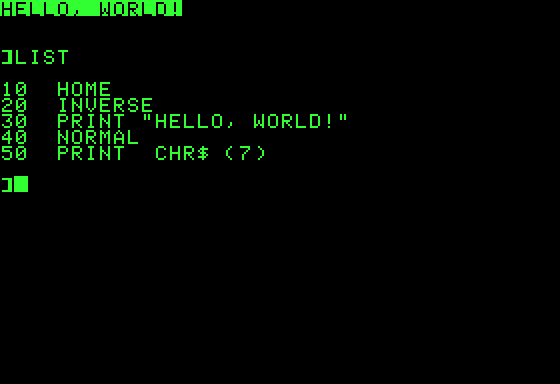 |
| Seems a bit basic don't you think? |
Another important language would have to be C. It was released in the early 1970s, and it enabled programmers to have much more control over how memory was allocated during the run-time of a program. It is a very structured language is known for being very efficient when the program makes the transition to actual machine language. The language is so versatile that it spawned a couple of newer versions; namely the object oriented languages C# and C++, which are still in use today. In fact, C is such a widely used language that many computer science degrees require a class in the C language as a prerequisite.
While I have talked about a select few hardware milestones and languages, there are still many important contributions, like the IBM PCs (1981) and Cray Supercomputers (1960s), along with important languages like Java (1995) and FORTRAN (1957). Every one of these has left their mark upon computer science as we know it.

No comments:
Post a Comment