When you
think about Artificial Intelligence, chances are that what comes to mind first
is robots rising up and destroying modern civilization. Well, I can guarantee you
that is not going to happen, at least not for a good long while. In a nut
shell, A.I. (Artificial Intelligence) is the ability for a computer or a
machine to make decisions based on some past experience. There are some A.I. that
can perform an operation based only on a specific list of actions that they can’t
deviate from, while there are those that take in many different variables, and
adjust their actions accordingly. Some examples of the former are programs that
control an automobile assembly robot and automated customer service lines,
while the latter include experimental self-driving cars and the routines that
control an enemy soldier in a video game. Right now these A.I. are very
rudimentary, but as time marches on and processor power increases, they will become
smarter and more complex. We needed a method for figuring out just how smart a
computer can be, and that is where Alan Turing comes in.
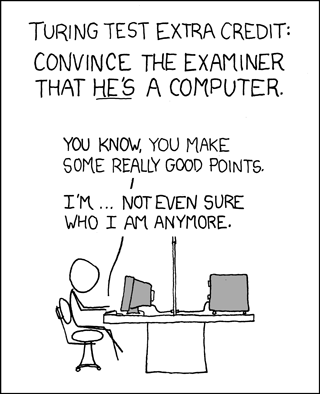 In 1950,
Alan Turing proposed just such a method. The Turing Test, as it is known today,
is used to test computers for the presence of active intelligence. What Turing
proposed is to have three participants in the test: a person, a computer, and a
human questioner. The questioner is to have a number of conversations with both
the computer and the person, and at the end of the test, decide who is human
and who the computer is. Turing believed that if the computer is able to fool
the questioner at least 70% of the time, then the computer is said to have
passed the Turing Test. Turing proposed this over 60 years ago, and
unfortunately, that 70% success rate has not been attained yet. There is one
program that has made some progress on the test through, and it is known as
Cleverbot. Cleverbot is a website that lets users have conversations with a
computer. Cleverbot is actually a pretty interesting in that more conversations
it has with users, the more it “learns”. Repeated conversations with users
enabled the algorithm behind Cleverbot to associate words and sentences with
each other, and then it chooses the best response for any given question or
statement made by a human. As impressive as it sounds, however, the best that
the program has been able to achieve is a 60% success rate. This just goes to
show that even with all the advancements that we have made in the field of
computer science, we still have a way to go before we are able to see complex
A.I. be able to pass themselves off as humans.
In 1950,
Alan Turing proposed just such a method. The Turing Test, as it is known today,
is used to test computers for the presence of active intelligence. What Turing
proposed is to have three participants in the test: a person, a computer, and a
human questioner. The questioner is to have a number of conversations with both
the computer and the person, and at the end of the test, decide who is human
and who the computer is. Turing believed that if the computer is able to fool
the questioner at least 70% of the time, then the computer is said to have
passed the Turing Test. Turing proposed this over 60 years ago, and
unfortunately, that 70% success rate has not been attained yet. There is one
program that has made some progress on the test through, and it is known as
Cleverbot. Cleverbot is a website that lets users have conversations with a
computer. Cleverbot is actually a pretty interesting in that more conversations
it has with users, the more it “learns”. Repeated conversations with users
enabled the algorithm behind Cleverbot to associate words and sentences with
each other, and then it chooses the best response for any given question or
statement made by a human. As impressive as it sounds, however, the best that
the program has been able to achieve is a 60% success rate. This just goes to
show that even with all the advancements that we have made in the field of
computer science, we still have a way to go before we are able to see complex
A.I. be able to pass themselves off as humans.
For information about the Turing Test visit this website.

Hey Matthew,
ReplyDeleteI really like your introduction! Well I'm kind of biased because that’s really similar to my introduction but nevertheless, great post about AI. It's awesome how you included the history of AI and the development of it through the years and some examples of AI. It was fun playing around with Cleverbot and seeing what responses it gave me so thank you for helping me kill some time on my break from finals. Great post once again and keep up the good work!
Hello Matthew,
ReplyDeleteI find your introduction to be humorous, engaging, and informative. You listed many examples on what Artificial Intelligence has done so far. I liked the fact you included the history of AI and the Turing Test. Thank you for providing the link to cleverbot. It was nice playing around with Cleverbot and found it fascinating when typing in another language, it seemed to respond back with the similar language. Overall great post and keep up the good work.
Great Comic ! Really informative and interesting blog. I have used Cleverbot but never heard about the Turing test. It is amazing what Computer Scientists have accomplished but as demonstrated by the Turing test, there is still a limit on how much we can do.
ReplyDelete